
Neurology
Parkinson's disease is relentless.
Managing it shouldn't depend on memory.
At Newel Health, we are building the digital infrastructure for continuous, personalised Parkinson's care, combining wearable sensors, real-world data, and AI-guided clinical support to give patients and neurologists what episodic care cannot.
The condition
The fastest growing neurological disease in the world.
Still managed through snapshots.
Parkinson's disease affects around 12 million people today and is projected to reach 25 million by 2050. It is a complex, fast evolving condition, with symptoms that vary across patients and can change within the same day.
Yet care still depends on occasional visits. Between appointments, patients are left to manage a shifting disease largely on their own. And when they finally see their neurologist, decisions are often made from memory, not continuous visibility.
In a disease this dynamic, snapshots are not enough.
12M
people living with Parkinson's today
25M
projected by 2050, a 112% increase
#1
fastest-growing neurological disease by prevalence
Minutes
duration of the average neurologist appointment
Why current care falls short
Levodopa is effective.
Dose optimization is the challenge.
Levodopa remains the most effective therapy for Parkinson's motor symptoms, but its management becomes increasingly complex as the disease progresses.
As the therapeutic window narrows, patients fluctuate between ON periods, when symptoms are controlled, and OFF periods, when motor function deteriorates. Dose adjustment requires precise understanding of symptom timing, duration, and variability.
In practice, treatment decisions are often based on brief consultations and patient recall, with limited visibility into symptom dynamics between visits.
The result is frequently suboptimal control, with avoidable OFF time, dyskinesia, and reduced quality of life.
The clinical rationale is established. What has been missing is continuous, objective data to guide individualized treatment.
Our work in neurology
Our contribution to this space.
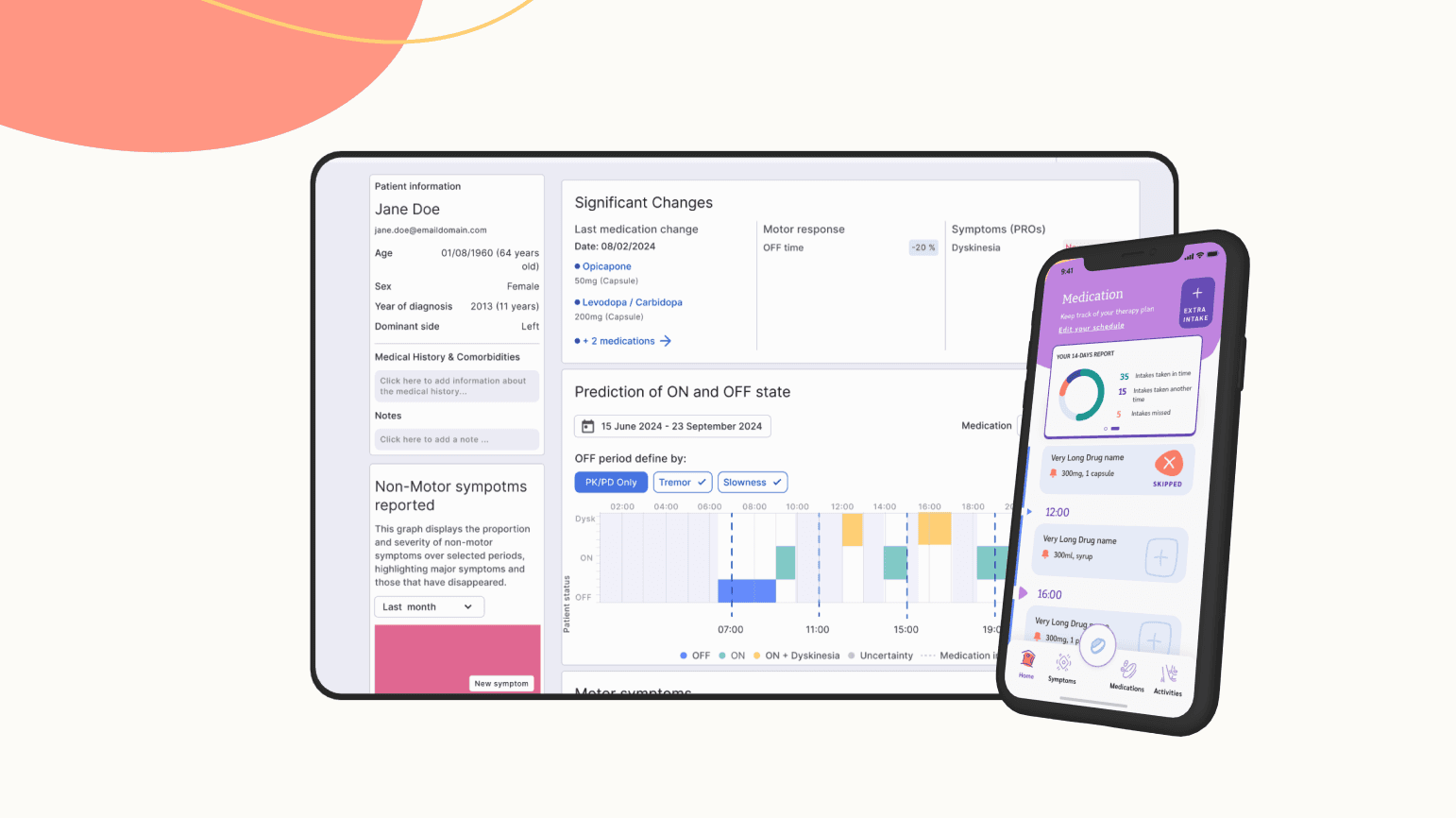
Soturi reflects Newel Health's ambition in neurology: to make Parkinson's care more continuous, objective, and precise. Developed with Orion Pharmaceuticals and supported by $2.5 million in funding from the Michael J. Fox Foundation, it combines mobile technology, wearable sensors, symptom tracking, digital biomarkers, digital endpoints, and AI driven decision support to give neurologists a clearer view of symptom progression, treatment response, and medication effects beyond the clinic. It is designed to support more precise levodopa and levodopa equivalent dose management through a more continuous and data driven model of care. The clinical study is active across three centers, with more than 60 patients generating an average of 12 hours of data per day.
 Learn more about Soturi →
Program partners
3
Clinical study centres
60+
Patients enrolled
12h
Avg data per patient per day
$2.5M
MJFF Phase 1 grant funding
Wearable sensors for real-time motor fluctuation capture
Digital biomarkers quantifying tremor, gait, and dyskinesia
Daily patient-reported outcomes replacing quarterly recall
AI-driven levodopa dose optimisation decision support
Clinical dashboard with continuous patient data for neurologists
Building in neurology or neurodegeneration? Let's talk.
Soturi's architecture is designed to extend beyond Parkinson's into other neurodegenerative conditions. If you are developing a drug or device for Parkinson's or another neurodegenerative condition and need a digital companion, endpoint, or patient support program, we would like to hear from you.